
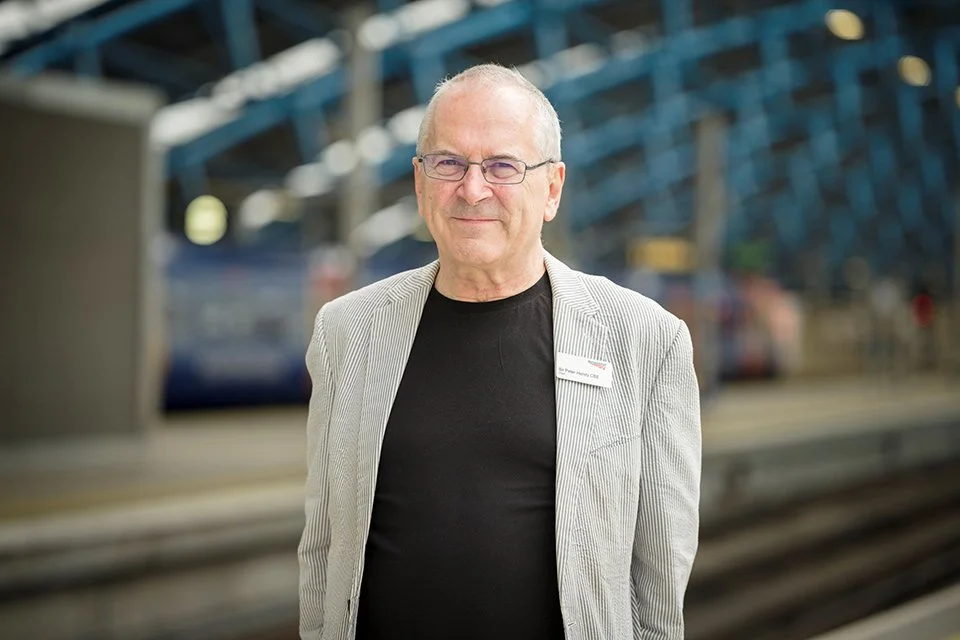
Peter, Lord Hendy of Richmond Hill , CBE
Image Credit: UK Gov
Peter, Lord Hendy of Richmond Hill, has dedicated his working life to improving London and UK wide transport.
His career began on the buses, as a conductor during the long, hot summer of 1976, travelling up and down the King’s Road on the number 11.
In 2001 he joined Transport for London as Managing Director of Surface Transport, overseeing the capital’s buses, roads and river services. He chaired the 2012 Games Transport Board during the London 2012 Summer Olympics and London 2012 Paralympic Games, delivering one of the most complex transport operations in the city’s history. He later served as Chair of Network Rail from 2015.
Appointed CBE in 2006 and knighted in 2013 for services to transport and the community, Lord Hendy remains closely connected to London’s transport heritage, still maintaining two Routemaster buses that he takes out on charitable runs each year.
He was appointed Minister of State at the Department for Transport in July 2024.
Lord Hendy has been at the centre of London and UK transport for 50 years.
Listen
Read
-
“Yeah, yeah. I'm also in touch with people I went to school with actually. I know a couple of people I've known since the age of nine, which is remarkable. And actually I think in terms of personal influence, I would put the school experience above university, though that was a good intellectual experience and a good introduction to adult life. But I still know several of the people that I went to school with, we go out for dinner three or four times a year. And also I'd worked, which was really interesting because I think that, y'know, modern kids today who follow that route from school to university come out the other side without much idea about what the working environment is like. And actually I did know what it was like because done it for a year. And then when I started work with London Transport, I learned more about the working environment because I went around a whole variety of different jobs including being a bus conductor and a bus driver. And they were very formative experiences too.’
-
“No, I always wanted to do things in transport and from that point of view, I've done what I set out to. I wouldn't claim that I ever wanted to be in charge of anything much. I didn't know, I wouldn't have known what that meant, but I was really interested in it. I think the difference is, and the difference even for today's young people who are interested in buses and trains and transport is that you are interested in the hardware vehicles, the locomotives, the routes, where they go, who – where they go. But actually when you work in the industry, it's the people. It's both the people who work with you and the people that you serve. And actually they're far more interesting in a way, because what I now know, and I knew it, I think I probably knew it then, was that actually the way in which London works and is laid out, the geography of London, how far it's been developed, what's where in the city, has all been determined by transport routes. But through that, you affect people's lives and actually most people's lives are home-to-work, maybe a bit less now with post covid, but still largely home-to-work, home to public institutions; schools, hospitals, leisure, that sort of stuff. And actually the layout of the transport network, how it works, what it does is actually pretty central to people's lives. And I still find that, and the people who work in it, absolutely fascinating.’
-
“I think actually, as I've grown through my managerial career, what strikes you again and again is that you achieve very little yourself on your own. The bigger the institution, the more that's true. You achieve much more by working with people. And as a team, I mean the best team I've ever worked with really were the people who worked with me at TfL when I became the commissioner in 2006 and I didn't do what some people in big managerial jobs do, which is come in and clear everybody out and start again. I think that's utterly foolish, apart from anything else, because the only difference between people and you don't know, is you might know what's wrong with the people, but you dunno what's wrong with the people. You dunno until you employ them.
And so actually a better bet is to work with the people you've got. And I inherited a great team of people. It was not well managed by my predecessor and nearly all of them stayed all the way through my nine and a half years there, and they were great people to work with. We made all the decisions together, apart from one or two, which were so crucial I had to work out actually what to do. But we made most of the decisions and I took the responsibility for them, ‘cause I was in charge. And I think that distinction's really important. If you do any work w- y’know, London- TfL employed 35,000 people and probably the same number of contractors again, so you can't do their jobs, and you need a management structure where you need to decide what it is that needs to be done, delegate it to other people to do it. But actually working with people who are knowledgeable, skillful, and became collaborative, is joyful, actually. And it's the only way of doing those jobs. Don't let anybody ever tell you that the person in charge-, the person in charge creates an atmosphere in the organisation and to some extent the culture, but they don't do all the work. And I'm very clear about that. So, that wasn't a partnership, it was a group of 6, 7, 8 people and we just made the whole place work, and we knew what we needed to do. We survived a change in mayor and it was a great job to do it. And actually, they're all my friends still. That's about. Here, if you chair an organisation like this, it's not the same as being chief executive. But I've got a brilliant chief executive, Andrew Haines, and I regard that as a great partnership. And I think he would say so too if he was here, actually, he does all the hard work, with his team of people. He and I together work on the circumstances which allow him to do as much as he can. Really the politics and the economics of it.”
-
“Well, so I think it derives from a view about what you're trying to do. So my standard speech, which is not very interesting, but transport; railway, TfL, whatever it does, is about connectivity. And connectivity drives economic growth, jobs, housing, social cohesion and sustainability. So it's really important, and therefore it ought to run well. And these are operating organisations, they have a daily job of carting millions of people and railway's case freight about. So actually, you want it to run well. And when I became, well actually every job I've done, including earlier in my career running a bus company, the first requirement is to run the place properly on a daily basis. Because actually what I've learned is, if you don't do that, nothing else you say is of the slightest interest to anybody. And I used to wake up at TfL, look at my Blackberry, as it was then, work out how the system was running and I used to tell the mayor. A, because he needed to know in case he was on the media, and B, because I wanted him to know whether we were doing all right or not. Everybody knew that I told them that, and they knew that if it wasn't going well, that he would know it wasn't going well and he was the big boss. But actually by 10 o'clock in the morning, you've either taken everybody to work or you haven't. And then if you go off and try and make a speech about what the next 20 years has to offer and you've just disrupted 200,000 people's lives on the Northern Line, they're not interested in what you say about 20 years. And it's a constant battle because actually these systems are very old, they're very complex, they rely on thousands and thousands of people interacting and they don't always go right.
So, on the railway, every morning before you've woken up, something's gone wrong. Two or three things have gone wrong from Wick to Penzance and people are trying to fix them, or they bloody well ought to be. But actually, the people out there, the customers, the passengers, make a judgment in the end, about how well you are doing, and you've got to try really hard to do well every morning, and the system's got to work for them. And I think at TfL, I think the great thing we did was A, prove that it ran reliably enough for people to believe it was a competent organisation, and B, we made their life easier through Oyster and contactless and good information and automatic refunds and all that sort of stuff. And that's actually what people want. And if you put it like that, it sounds really mundane, it's not, it's bloody hard work to get all that done. but the philosophy of what you are asking people to do, asking the organisation to do, is firstly to perform on a daily basis, then it's got a whole load of other things to do, which are policy things and developments and renewals and replacements and enhancements. But you don't get any credit for that if it doesn't work. And I hope that people would say, if you ask them, that at TfL, when I was there, and I know that quite a lot of people would say in Network Rail, that Andrew and I, and me and the management team at TfL were trying to make the place work. And I think that that is, it's just really important. And it's just different in a public service than other things. I met Justin King once, he was the chief executive of Sainsbury's, and I said to him, ‘Does anybody at your annual general meeting ever ask you why the baked beans aren't next to the toilet rolls?’ And he said, ‘No, no. People don't ask that. Those sort of questions.’ But in my world, they do actually, no matter what, I go and went to talk about TfL y'know, 20 year vision, Crossrail, all the planning and the connections doing planning and transport. The second or third question was always, ‘Why doesn't the piccadilly line stop at Turnham Green except after 10:30 at night, and on Sundays?’ And if you didn't know the answer to that, they just thought you were stupid. What was wrong this morning with the Central Line? And if you didn't know, so what it tells you is that actually how well the transport system works, is an integral part of life in the city and so it ought to be, and therefore you've got to judge your success on what you see. And even though I'm not in charge here, 'cause Andrew is, every morning, I look at what's going on on the National Railway system, I spot what's wrong, sometimes he and I have a discussion about it, quite often it's an infrastructure fault. We've got to get it right, 'cause people depend on it. And that seems to me to be a very simple philosophy. And then you've already admitted that it's all teamwork, it's all collaborative work. There's nothing you can fix on your own in these systems. There's nothing you can do as a hero, which will make them work. Other people do the work. So their motivation, their keenness, your understanding about what they want to do. And to take it back to where I started actually, I think, that one of the strengths of the approach that I've always had is that I had driven, I have conducted buses and driven buses. I've been inspector, I haven't driven a train, I didn't go on the tube, I went on the bus service. And I think I've got a reasonable understanding about how the workforce feel about those things. And I think that's important for motivation. I don't want them to think that I'm some posh bloke in a big office who doesn't know anything about what goes on there. ‘fact very unusually, I didn't put my badge on today, which I generally do because when I travel to work and go home, I wear a badge with my name on it and what my job is. And I did that at TfL. And I think all the management ought to do it. 'Cause our staff have to do it, and I know how they feel. And I've driven a bus in London and I know that on a wet November night when the heaters not working very well, all you want to do is get a bus back to the garage and go home. And I think it's really important to have a bit of empathy with working people, not to tolerate bad work, but actually I know what it's like to do some of those jobs and that's sort of stayed with me.”
-
“Well, I think if you are responsible for one of these systems when you are traveling, I don't mind if people know who I am, I'm the chair of Network Rail. Occasionally people ask me questions about what's going on. And if I know, I tell 'em. And at TfL laterally, one of the things that was really nice was that people used to come up occasionally and say, ‘Do you know what? I think it's got a bit better since you're in charge’. And you think ‘that'll do’. They're never going to say it's perfect, because it never is. But if we ask everybody on this station to wear a uniform, it's not a big ask for me to wear a badge saying who I am. And anyway, it's quite nice for the staff to see the people in charge of that. Andrew and I wear them, everyone at TfL wears them. It, it's just the right thing to do actually. And we’re not grand people. We might have big jobs, but actually we're not too grand to, I do travel inquiries out here sometimes. I know how get most places, I can help people who don't. That's all right, isn't it?”
-
“Oh, well, it's important to the city actually. I mean, I think if you start from my proposition that connectivity drives growth, jobs and housing. If you look at the development of London, then the development of the transport network is very clearly has resulted in London being the shape it is and how it works and what it looks like. Of course, it's altered through the years and every so often there are big, big, big redevelopments, the bombing in the Second World War altered the face of London. But, it defines the place, in a way. And you can point all over London to things that happened, that made a difference. So if you look at a different part of London, the Great Eastern Railway extended from Shoreditch to Liverpool Street in the 1870s. And part of the deal was they demolished a huge quantity of slum housing to get there. Liverpool Street’s in a cutting when you get past Shoreditch, and they just demolished all these hovels and some dwellings which were full of people, and the act of Parliament that enabled them to do it, it obliged them to run very cheap trains to places like Walthamstow and Chingford. And now if you look at Northeast London, they're rows and rows of terrace houses. Some of 'em are really nice now, which were built as a consequence of the Great Eastern needing to build Liverpool Street. And if you look at the alternative example, which is on the Great Western at Paddington, the Great Western thought, it was a long distance railway. And in fact, the first station out of London for a long time was Ealing Broadway. And it didn't encourage workmen or third class passengers at all. So the development along the route of the Great Western is quite different.
So if you look at Camden, then the extension of the London Birmingham railway to Camden in 1837, I think I'm right, produced a massive change in the fortunes of Camden. And in fact, the guy we were talking about; Peter Darley's book is very good testimony on the huge scale of change, but then it brought a load of development, as a consequence. And therefore, that early railway, 'cause it was quite an early railway, the remains that are there, are very- are indicative of a massive social and economic change that occurred as a consequence of it. Not all of the remains are in good shape. The Roundhouse has survived, changed hands several times, fortunately. And then later the North London Railway coming across Camden viaduct was an essential part of opening up both the route to and from the London docks for freight and also travel to the city, because it stopped at Broad Street. So you've got quite a lot of relatively posh housing in Camden, Hampstead and so on. And that was their connection to work in the city of London. And it also connected working people with working in the docks and other places. So, for me, if you look at a city, you can't disconnect it from the transport network and the industrial heritage of it. While some things should have survived and didn't, other things do still survive and are very powerful reminders of how the place developed.”
-
“Yeah, it moves, doesn't it? It moves. I mean the areas between Camden and Islington, were real working class places up to Holloway and so on, for many, many years. In my lifetime, things have changed quite dramatically. I can remember we used to go and see people by Trolley bus to Parliament Hill Fields. My mum and dad had had a friends who lived there, they were quite posh actually. But on the way you went through Kentish Town, which was then full of terraced houses and working class people. And the reason it was a trolley bus route is because it had been a tram route. And the reason it was a tram route was, or actually the growth of electric trams, which were cheaper than buses, was a great determinant of how much working class housing there was around the place. Now the same houses now change hands for two or three million quid. So they're different places to live. But London's evolved like that constantly. Both of my kids who are in their thirties, one lives in E2 and the other lives in E1, if my father was still alive, if I told him that his grandchildren were going to live in Shadwell and off the Bethnal Green Road, he would've been flawed by it. I mean, those places then just were full of densely packed working class people. But the city's evolving constantly. But its shape was determined by the transport networks of the 1830s onwards, really.”
-
“Well, I love it too. I think it's, for me, the whole, actually I'm not quite up to date on bus routes anymore ‘cause I don't do them here, but the whole development of London is the history of the evolution of those services. In Camden actually, so I moved to Islington in 1979 when my parents retired to Cornwall, so I lived in Grosvenor Avenue, nearest station was Canonbury, and the North London Line then was very run down and British Rail tried to close it actually. Unbelievable, really. But one of the things that GLC instituted was the train service from Camden Road Eastward to Hackney and Stratford, which hadn't run since 1940 - It was closed down in the war because of bomb damage. And actually in that 40 years. So that's now part of the overground. There's now new stations at Hackney Wick and Homerton and decaying station at Canonbury now has an extraordinary train service.
And that's changed the nature of the place completely. So if I can watch that in the evolution of my life and I'm 71, you can trace it back to it being built. It's just so interesting. And the tube map is iconic, but actually quietly, constantly changing. Get one from eBay, which is 30, 40 years old and there's, there's quite big differences actually. Well, the Elizabeth line. The bus route map is always changing with the exception that some things are completely static. So there are some new numbers. I'm very uncomfortable with route numbers over 299 in Central London that was never like it when I was a kid. So there are routes with three and 400 numbers now. There are so many of them because they're shorter, so there are more routes. But the 24 has run between Pimlico, Hampstead Heath via, Camden Town since 1911, I think. And it's never changed its terminals.”
-
“Well, I think it's brilliant so that most of that viaduct hasn't been used by trains for a very, very long time. I saw somewhere that actually parts of it haven't been used since about 1880. And I mean that railway, as I was saying, has changed its function over the years very considerably. It used to be connections very largely to the city of London, Broad Street and/or Poplar and London docks for both freight and passengers. And now of course it's part of a very high frequency network, but it still hasn't used all that vacant land, which has just been derelict for as long as anybody can remember it. And I think turning it into a public amenity is just a brilliant thing to do. I'm very supportive of it. And one day we might need bits of it for the railway, but it won't be any time soon, so let's not worry about that.
So let's do something nice with it now. And I think the plan for it is absolutely stunning. It is not quite the New York highline, ‘cause it's still got trains running next to it, but it'll be pretty good. And the other thing it'll do, which I know from the Olympic Park, is one of the things that poorer people in London don't get much of is green space. And actually green space is not only place to play football, it's a place to walk, it's a place to admire nature, it's a place to relax. And for all those reasons, it's also a really good thing. It's not like the whole place is full of parks. There are some parks, Regent's park, Hampstead Heath, but they're quite a bit away. And actually doing a bit for the environment and giving people some space to breathe and play and think and sit is just great.”
-
“Well, I've been talking quite a lot about it this year because of course Paris is about to start. I talked to two groups of French people. I went to Paris, one of 'em. It was very nice, for a day. So I think, if you go back to what I think you're trying to do, what you're trying to do in a transport organisation is make it work well. And actually what we tried to do for the Olympics, knowing that it would put pressure on the city and its transport system was to make it work the best we could, bearing in mind what we needed to do. I fell out with the IOC quite early on because I remember being pulled up by one of these rather pompous people who fly in and then fly out, he said to me, I don't think you've made sufficient preparation to make these games successful in your city.
And I thought, okay, well if that's what you want to say. I said to him, ‘Listen, I've got two things to do; I've got to make the Olympics successful, but I've also got to keep the city running. And you are only worried about one of 'em, but I'm worried about both of them’. It was really hard work. We did plan it. There was a lot of investment which was started fairly early on, and of course it was coming in things like channel tunnel rail into St Pancras, all that sort of stuff. But we worked really hard to try to make it work. I mean my memory of this time 12 years ago is that we were under a media barrage of enormous proportions who said, because they didn't have anything else to write about because the games hadn't started. So they just said, ‘well, the transport was crap and it's all going to break down and it won't work, and all this sort of stuff’. And actually we thought, well, I mean the media, write, well, what the media write, don't they? But actually it was all right. It did work quite well.”
Alex Ross (interviewer):
“It was amazing. I think everyone remembers”
Peter Lord Hendy of Richmond Hill :
“I think. Yeah, I remember it too. And I think that actually if you go to what you are trying to achieve, you want it to work well, you want to take the people who make it work with you, you want everybody to know that if somebody's going to look at what you're doing from all over the world, you'd like it to look good. And actually, I think by and large, we did achieve that. One of the things we did was that we took everybody who worked for TfL and quite a lot of contractors, we did seminars for them, about 120 people at a time in a unused part of Stratford International Station. And we told them about the Olympics and senior management did them all, we did some at night for people who worked on the track at night, all that sort of stuff, and then afterwards we took each of them on a bus tour of the Olympic Park and at that stage, nobody had been in it, but it was nearly finished. So you could see what was going on. And of course it had absolutely the effect we wanted it to because all these men and women went back home and said to their husbands and wives and families, ‘I've been in the Olympic Park, I know what it looks like. It's going to be fantastic’. And we thought it would motivate them, and I think it did. I think they thought, blimey this is quite something. And we had a great summer in the end, but I sympathise with people who are putting it on now ‘cause the media is still the same. When I was in Paris, it said, ‘Oh the transport system's not going to work. Staff have got to go on strike, the Metro'll break down’. All this sort of crap. They've got nothing else to write about. They stop writing about it when you start winning gold medals. The day we won the first British gold medal, all the negative comments about the transport system just evaporated because it got something different to write about.”
-
“Well, look, I'm very lucky. I mean, if you think about the things that matter to people's lives, actually I'm white, male and English. That's pretty handy. And there's still, even today, sadly, there's quite a lot of discrimination. I did face discrimination against youth, believe it or not, earlier in my career in the old London Transport was a very staid place. It wasn't well run. It didn't perform well. That's the other reason that I'm so passionate about performance, because I joined an organisation that worked really badly. Bus service was 20 or 30% of the service was canceled. The tube was filthy, train service was unreliable, and the management were all well, wafting around the place in shofar-driven cars. So, I mean that gave me and a few other people a real feeling that actually if you couldn't do better than that, you weren't very good at all.”
-
“So organisational change, especially in big organisations, is the real driver to get younger people promoted. And actually, I keep telling audiences here that virtually every one of the jobs I've ever done has been created through organisational change. Because what happens in a big organisation is every time there's a change, some of the people have been there a long time retire and go, and they need to recruit new people, and if you need enough new people, you can't recruit people who you think are certain to do a job, you recruit people who you think might be able to do a job. And in 1988, London Buses created 11 bus companies, smaller, more compact bus companies with a view to A, run it, having them run better, and B, privatisation. And my mate, Steve and I were appointed the managing director of two of them, and we were both summoned to see, separately, to see the guy who ran London Buses. And he said to both of us, each of us separately, he said, ‘Well, we're not sure whether you can do this job or not, but we've had to appoint you because we haven't got anybody else’. And it was quite hard to know what to make of that. But actually we both thought, well stuff it then we'll show 'em. And we did. But that was really interesting, wasn't it? I mean, I can't believe that somebody would say that today. You'd rather hope they wouldn't. But actually there'll be some big change in the railway because of a new government and the consequences, there'll be a lot of jobs that there won't be an obvious person to fill 'em with.
And the best thing you can do is fill it with somebody who's bright, who's keen to learn, who listens to people, who's got empathy with the people they're going to control and say, ‘Why don't you do this? It might work’. And I think that's perfectly reasonable and that actually is one of the antidotes to sexism, racism, and everything else, which is actually you should look at the workforce, you should encourage the workforce to get on to apply for promotion and you should appoint people you think might be able to do the job. That'll do me. That's quite a good way of doing things.”
-
“I'd never agreed- I didn't think privatisation of London bus companies needed to have happened, it was a political act. It wasn't an operational act. Now, the truth is the service hadn't run very well and the managerial changes they made to prepare the companies for privatisation were good changes. They didn't actually need to be sold, it was a political act to sell 'em. But I can remember very clearly thinking to myself, well, when you find yourself in a sales brochure with a picture of you and your colleagues saying, this is the management team who'd like to buy this company, it's quite, and actually at first I thought, well, I don't want to want to do this. I'll work for somebody else.
And one of my friends in the bus industry, actually I'll just ring up, said to me, ‘Well, don't be so stupid. If it's a sale, you might as well try to buy it’. And we did and we became instant capitalists overnight where the money from the bank and venture capital, we did employee share ownership, which was a real experience. And then we sold it on because we had to, because you couldn't borrow any more money. And everybody who worked for us, got between 4 and 6,000, which is not bad, actually, not as much as I did, but I was in charge of the bloody place. But actually that was a political act, the privatisation of the buses. It's never been reversed. It probably never will be. Does it matter? Well, actually when I got in charge of TfL, did you want to change it? No, not really, because it actually, things have moved on.
The railway is a shambles. I mean, Andrew and I do our best, but it's a terrible structure. We are both deeply motivated to change it. And the sadness of the government that's just going is that they've had a policy to do something about it, but they've not actually achieved it and it's not the right structure and it doesn't deliver the right results. Is that inevitable? Well, it is because if you consume vast quantities of public money, then politicians make decisions, and quite often you don't get listened to. When British Rail was privatised 30 years ago, the management of it was absolutely united to say they shouldn't do it in the way that they did, but they did it anyway. Now we're trying to put it all back together again because it's the right thing to do. So I don't have to be proud of privatisation. It was done to me. It wasn't done with me. I didn't leave London Transport, it left me. When I went back, I went back when TfL was formed and actually that was okay. So I've been a capitalist. But was it necessary? No. Would you change it now? Probably not, because it's too hard. Are the working conditions of bus drivers in London as good as they were 30 years ago? No, they're not. That's one of the consequences, actually. On the other hand, on the railway as left, the train drivers have done fantastically well. They're probably the biggest beneficiaries out of privatisation. They've actually made a market for train drivers. Well, bloody good luck to them. Not good for the taxpayers, but it's good. But you live in a world where things happen to you, and the question is, do you adapt to them or not? And I thought, listen, we run quite a good company. We ran quite a good bus company. We thought we were doing all right. We bid the largest possible amount of money to buy it and we bought it. That seemed a pretty good outcome. Should it have happened? Probably didn't need to. We could have managed quite well without it.”
-
“Well, they live in Stamford Brook Bus Garage in West London. They used to live at Westbourne Park because I owned Westbourne Park in the bus company for a bit, and I know all people there. But we moved them to Stamford Brook because they're undercover and actually coincidentally, they're nearer home, which is quite helpful. And I do stuff for charity. So I am an auction prize at charity auctions. Me driving the bus, and we raised quite a lot of money actually. So I'm a trustee of the London Transport Museum and they have a dinner every autumn. So me driving the bus, taking you where you want to go is always an auction prize. Two years ago, we sold it twice for £37,000 each, which was pretty good actually. Just me driving the bus. So I do that. I do do weddings and things, but only for friends.
I don't do them for money. I do stuff locally. I had one of 'em at the street party on Saturday, last Saturday. That was good fun. Drive all the kids around. And we run a bus service to a place called Imber on Salisbury Plain, which this year is on Saturday the 17th of August, it's in the middle of the Sailsbury Plain training area, so you can't normally go there. It's a village that it was emptied of people in 1943 to prepare for the D-Day landings. But the church is lovely. It's 14th century and church is miraculously unharmed, so you get access a few days a year. And 15 years ago, my mates and I decided, where's the most stupid place you could run a bus service? And the answer is somewhere where nobody lives and you can't normally go. And we run a service to Imber and we made a few bob and over the years it's great. So last year we ran 30, well, we scheduled 37 buses, three broke down, so we scheduled 34. We ran 34, and we made 38,000 quid for charity in a day. It's not bad.”
-
“Actually, that's a hard question because actually all cities are made by their transport systems. If you look at a map of any city in the world, apart from cities that have no public transport, which are generally Saudi Arabia, a place like that, very dispersed, and they're all different. I mean, those of us who've got the bug, whenever you go to a city, you immediately search out the interesting things in the transport system and go and travel on them. I like the Paris Metro, especially the train. You are too young to remember them. But the trains that ran when I was a young man in Paris had hand operated doors, which you could open in the tunnel if you wanted to. And this sounds funny; they smelt of electricity and they did smell, so a modern tube train, when you see the chap at the front or the woman at the front driving it, they pull and push a handle and the whole power of the train isn't going through that handle. But in these trains it did. So there were massive flashes and sparks and it smelt of the sort of ozone that you get out of electricity. The other thing is they used to smell of cedar because the brake blocks was cedar wood. So the curious smells of the Metro, which included the sort of faint sewage smell, were always also of electricity and cedar, but almost any public transport trip in the world is interesting.
And actually our bus route to Imber is quite interesting. The 23A, which has a number, it's the only 23A, at least in Southern England, and it only runs one day a year, and we all like driving it 'cause it's such fun. I dunno, really. I mean, where'd you go on a train that you love? I like the views out of some of the railway journeys that you do. Barmouth Bridge in Wales. I was there about four weeks ago. It's gorgeous. Long bridge over the Mawddach Estuary in the sunshine. It was absolutely gorgeous, but the journeys are only part of it, aren't they anyway, as I said, the other thing is the people. I mean, try the Mumbai suburban railway. Have you been to Mumbai?”
Alex Ross (interviewer):
“I have.”
Peter, Lord Hendy of Richmond Hill :
“Church Town, is it Church Town? Church Yard, station. I mean, they carry some phenomenal number of people a day, like 7 million or something.
I went there with Ken Livingstone in 2007. They put us on a new, what was then a new train. And the old ones, I mean, you couldn't shut the doors on them. People used to travel on the roofs of course, which was fantastically unsafe. But the reason you couldn't shut the doors is because they were loaded with so many people that the under frame of the carriage was bent, so the doors wouldn’t open and shut. The Indian railways crush loading standard, which is, I must tell you what it is because it's extraordinary. It's in Wikipedia, where Is it? Indian railways crush, crush loading ...
'Super dense crush load described passenger loads on the Mumbai suburban railway with carriages built for 200, carry over 500, translating to 14 to 16 people per square meter'. I mean, that's quite something. When I visited them, when Ken was the mayor, and I went to see the bloke who ran it in his office and he said, well, we'll take you out. But he said, well, we better put you in the cab. You won't want to travel like our passengers do. And you couldn't get in. I mean, people were hanging off the side. That's an experience, isn't it?”
-
“But also because- the way the transport system works and where it goes is a determinant of the city, then actually TfL's business plan always has the next things you need to do to make the city work better and to get more housing and more jobs. And the present mayor wants to extend the DLR to Thames Mead. He wants to extend the Bakerloo line to Lewisham. And I mean, from my position, which is one step removed, if I still ran the place, I would've some strong views about what the best thing to do is. But I'm not there anymore, I haven't been there for nine years now. But what I do think is that actually those things, providing they come to pass, we'll change the city again for the better too, actually. Thames Mead's a horrible place and it's not a horrible place 'cause its naturally horrible. It's horrible 'cause it's so disconnected from the rest of the city. If you look at what Crossrail's done for communities along the line and route it's extraordinary thing and the DLR too.”
-
“And not all of it is good, but it's all interesting. I mean, one, the challenges with the Olympic Park is if you look at a place like Hackney Wick, I mean Hackney Wick, I can remember Hackney Wick before the Olympics... was a bus stand. I mean, the crews wouldn't go there on a Friday night ‘cause it was such a bloody miserable place and had so much antisocial behavior. Hackney Wick is now quite trendy. The problem is that a lot of local people on low incomes can't live there anymore. But what do you do actually, have we done something good or not? I think we probably have done something good because without comprehensive redevelopment you just get decay and it is a good argument to have actually. It doesn't really apply in a place like Camden because Camden's evolving out of the existing housing stock. But it certainly is an interesting debate at the Olympic Park.
One of the things that actually as tangentially I'm really pleased with; before Covid, we used to worry a lot that the breakdown of the people using the park was not the same as the people who lived in the local community. Since Covid, actually, one of the great things about Covid, there aren't many, but this is one of them, is that local people from East London started using the park and they've never stopped. And that's really interesting. We felt we had a great disparity of, certainly of ethnicity because people thought, well, it's too posh, it's not for me. But then they used it and they like it, so it's okay now. So the city evolves, it comes and goes and it'll keep going after I've gone and you've just moved it on a bit. That's what I've done.”
-
“So I was a bus conductor in the summer of 1976. It was a lovely hot summer. And for a young man actually going up and down the Kings Road on number 11 was like being paid to have fun really. And we also did 74 B, which was, I worked at Riverside Garage, which was then in Hammersmith on where the big office development at Central Island is now 74 B was Hammersmith to Camden Town. When we got to Camden Town, the stand was in Greenland Road. I'm not sure there is a bus stand in Greenland Road anymore, but if you got there early enough, the pavements in Camden Town were lined with blokes. There weren't any women, they were all blokes.
And at about 7:30 or so in the morning, a load of transit vans would turn up and they would pick up most of these people, but not all. And what they were was they were builders, there's a phrase called ‘the lump’, which actually doesn't exist now, thank God. But they were people who were hired on a daily basis and they were picked by the foreman. So the truck would draw up and the guy would say, many of them were Irish, not all of them, but many of them were. And he'd just pick people out the crowd and say, I want you, you, you, you, you, you get in here. And they would go off in a van and the people who were left behind had no work that day. And actually even in the 1970s, that was crude beyond belief. There weren't many places left like that. And the building industries now changed very dramatically for the better. But that's a very vivid image for me, which is that, I had a good job by then. A graduate trainee, that's a good job. And being a bus conductor was quite steady job by then. But there were these dozens and dozens and dozens of blokes and it would all be over by eight o'clock. They'd have gone off in a van or they went home. 'Cause there was no work. Actually, it's very memorable actually. I can visualise it still. And they were there every day of the working week, all the year round.”