Photography: Paul Romans
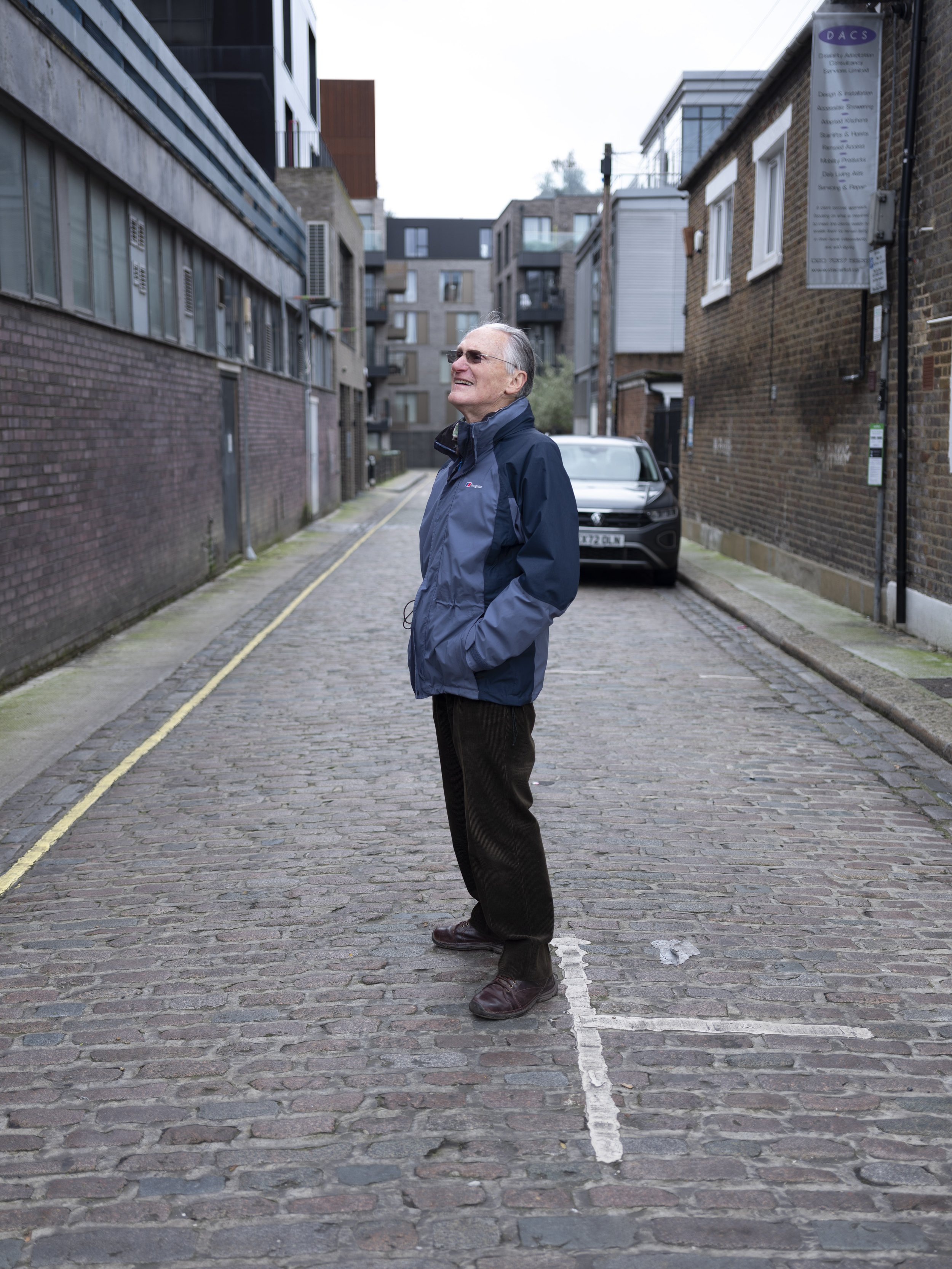
Victor Brilliant
Victor grew up immersed in the rhythms of Camden Town, where his family’s tobacconist and barber shop operated beneath the booking hall of Camden Road station. The business became a fixture of local life, serving well-to-do Camden regulars with their fix of tobacco and a shave.
Victor’s career brought him back to Camden Road, where, despite training as an accountant, he accidentally ran the family’s motor business for 35 years. He witnessed the area’s dramatic transformation; from industrial neighbourhood to creative hub.
In this Interview, Victor reflects on his memories of the past. We were lucky enough to visit the site of his motor business in Camden Road and see some photos from his grandfathers saloon.
Read
-
“My grandfather started off business in, in Hackney. He started off, I don't know why, I presume there must have been some connection back in Belarus. But he started off, he opened a, a tobacconist shop, tobacconist confectioner. And then when that was successful, he started opening more of the same. And he particularly came to Camden Town in order to aim his business at the very large, very affluent families in the big houses up Camden Road up around Murray Street and Camden Square, where the gentleman would live in those houses with their carriages kept in the muse at the back, and they would walk down Camden Road to the railway station to go, to go into the, into the city. And my father took this shop actually in the station underneath the booking hall. And there was, and he opened a salon du toilette, the, the, the station toilet saloon, where gentlemen could come in, walk in, buy their tobacco and their half a dozen cigars for the day, which would go straight into the breast pocket, and they would then go into the barber saloon to have a shave and hot towels and prepare themselves to go into the city.”
-
“My mother was not in terribly good health, and my father would very often take me into work into town. I would go in, I would, I would get my hair cut. I would be put on one of the barber's chairs with a little wooden platform across, across the arms so I could be raised up high and I would have my hair cut. And I remember, I remember the, the chap, the employee of the, of, of the business, who used to cut my hair, Mr. Berman regularly used to cut my hair. He had been, he had been, in an earlier life, a carpenter, and he passed me on all his old tools. So, so that got me interested in woodwork. But yeah, it was there, there, there was the, the stainless steel cabinet at the back which held all the hot towels to be slapped on after shaving. And I, I watched all these rituals. I don't think much of that happens these days.”
-
“All, all kinds of other things evoke memories, but I don't particularly remember what it smelled like. The, the front shop, which was in the in the station, was all kitted out in oak and brass with massive tobacco jars, with tobaccos from all over the world. I, I remember ‘Latakia’ as one name that was inscribed on a jar, and people would buy loose tobacco which was weighed out in beautiful brass scales on the counter. And I have those on the sideboard in my dining room at the moment. Just at the side of this was the entrance into the barber saloon, which was underneath one of the arches in the station. And I, I think it might have been acquired a little bit later, just around the corner at 223 Royal College Street. There was the wholesale department, which supplied the, the other branches of the tobacconist and all kinds of places in the area. I mean, we supplied the whole of North, Northwest London with wholesale tobacco, confectionery, everything from the Zoo at Regents Park… I don't know. The arches were pretty grubby, and originally, and until some work was done, I remember the water dripping and the stock in the warehouse having to be carefully moved so that water didn't drip on it. Although steps were taken later to prevent that.”
-
“I suppose in my later school years I didn't, I didn't come into Camden Town so much. I, when I, when I left school, I was article to a firm of accountants and I studied accountancy and eventually I qualified. And shortly after I qualified, my father and my uncle, who by now were running this tobacco business, they, they, they, they also had another business in which they'd invested, which was just up Camden Road. They, they'd bought a petrol station and garage premises. It was a really, really old fashioned garage with dirty black grease coating every surface. If you, you know, if you went in to take your car in for a service, you came along, you felt the need to have a bath and scrub off afterwards 'cause everything was so dirty. And I can remember the workshop manager very clearly, he was a character, a bit like Fred Dibnah, if anybody's seen Fred Dibnah. He was a, a steeplejack and they made a whole television program about him. But he, he wore pebble glasses like Fred Dibnah. And there was a manager who ran this business, looked after the, the, the car sales and so on, and generally oversaw the business. But this was just a, just an investment that my father and my uncle purchased. And shortly after I qualified as an accountant, my father came to me and he said, I'm afraid that the manager's been caught with his hand in the till and we've had to dismiss him, and we need somebody to look after this business for a, just for a few months until we can employ another manager. So it must have been in about 19, 1963, I went to work in the business for, just, just to keep, keep it going until they could employ a new manager. And somehow I got myself involved and I retired from that business 35 years later.”
-
“I was un- I was unaware of that, completely unaware of that, until things started happening around Camden Lock. I knew about that because we, one of our customers at the, at the motor business, which I was by then running, we, we sold spare parts. We, we had a, we had a, a distributorship in, in motor parts. And one of our customers had premises down by Camden Lock. And he, he got himself into problems, and he ran up quite a large bill, which he couldn't afford to pay, and he came to me and he said to, ‘Can you give me extended credit on this?’. So as a result of which I had quite close association with him, and he, I mean, he paid it all off, but he sold his premises to the first of the developments that were going on along the canal side, which led to the whole of the Camden Lock area as we know it now.”
-
“It was, it was clothing, interesting clothing, punk, punk clothing and all, all kinds of strange things. And I remember this chap, he, he was, he, he was absolutely in wonder that the premises, which the, the business his fa- his very much failing business, had suddenly become of such importance, so much in demand. Suddenly people were clamoring to acquire his premises because of the business that was developing along the canal.”
-
“Later on when we, when I started working at the motor business in Camden Road, and I, I became more aware of how the, the big houses were, which had been so affluent, which had actually formed the basis of my grandfather starting a business and becoming comfortably off, how they had gone downhill, they’d fallen into multiple occupation. There was a huge Irish immigrant community with the Irish Center around Murray Street, and I later became rather more aware of, of how difficult people had found it in the area. We had a very mixed customer base, clientele. We, we had actors and musicians who moved into the, some of the houses around Camden Square, which, having gone right downhill into multiple occupation, where now up and coming, I mean, Alan Bennett was there writing about his caravan neighbor oh, Billy, Billy Piper was one of our regular customers, she, she lived there. Sir Charles Groves the, the musician. So there were lots of, lots of, lots of fascinating people who'd moved back into, into an area that was coming up again having, having been really quite desperately poor.”
-
“Running the motor business, we had a new car franchise. We wanted to sell as many new cars as we possibly could, and the really good condition secondhand cars. But we took a lot of older cars in part exchange, which we didn't want to, we, we didn't want to risk our reputation by selling these cars, which we suspected might prove not to be as reliable as we would like. So it was necessary to dispose of them in the trade, quotes ‘in the trade’. And there are always these a, a few secondhand car salesmen with whom we dealt regularly. So if a car came in and, and it wasn't good enough, we, we would assess it and decide whether it was good enough for us to sell secondhand. And usually the answer was no. And it, and we would then have to contact Stan, Stanley or Bill, I won't mention surnames, and get, get a price from them.
Now, bill did not have his own premises. He, he came and he gave us a price for a car. And we would, we would haggle a bit, and he would take the car and he'd pass it on to any one of numerous secondhand car dealers. And we really did not want to know what happened to it after that. Stanley was in Camden road, he was just up the road from us, and he had his own secondhand car premises. And he, he was quite a character. He'd actually been in the Air Force with my uncle, who was my father's brother. They had been in the Air Force together. And he, he, he was one of the regular characters who would, I would visit walking if I ever walked up from 85 to 89 Camden Road where we had the business, up to the corner of Brecknock Road, where we had our second hand car showrooms, I would go past his premises and pop in for a, a cup of, a cup of a cup of tea. No, not coffee. We didn't drink coffee much in those days. So there was a cup of tea. And probably if it was prior to the 6th of November, 1969, I would have a cigarette as well.”
-
“And in there, I don’t know whether you can see, above the pan for the weights, there is the weights- the pans and the weights from use would wear, and probably the pan with the weights in it, because it was having brass weights put in and taken out would wear more quickly. So eventually that side of the scale will become heavier than that side. So in there, there is a little brass container, which you could open up and put grains of rice in, in order to bring it back into perfect balance.”
Listen
Photography: Paul Romans